
Hanging Woven Panel Screens
Showing all 2 results
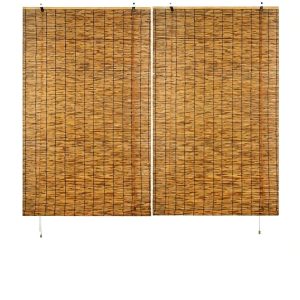
Carbonized Reed Hanging Panel Screen | Dark Room Divider
Read more
Natural Reed Hanging Panel Screen | Ceiling-Mounted Divider
Read more

Hanging woven panel screens, made to your drop
A hanging woven panel screen is a fixed panel suspended from the ceiling rather than standing on legs. No floor footprint, no hinge line, nothing to knock over — which is why restaurants, hotels and retail interiors specify them for zoning a room that still has to read as one space. We weave the panels in our own workshop in Shandong, China, and build them to the drop and panel width the drawing calls for.
The same construction runs in reed, split bamboo, seagrass and paper rope. Where a buyer needs light control rather than a full partition, the same workshop produces roll-up reed blinds cut to width: the panel hangs from a small headrail and rolls up out of the way, so one product family covers both the fixed screen and the adjustable shade.
What we produce
Ceiling-mounted panel screens — single panels or runs of 3–6, hung from a track, a rod or individual ceiling hooks.
Roll-up reed blinds — cut to your width and drop, standard roll-up hardware, indoor and covered-outdoor weaves.
Reed doorway panels — shorter drops for door openings and pass-through gaps.
Multicolour panel sets — mixed-tone runs sold as a retail programme.
Specifications
ItemStandard
MaterialNatural reed, split bamboo, seagrass or paper rope, hand-woven into panels
Panel widthCut to your specification; modular widths joined for wider openings
DropCut to your specification; up to 300 cm in a single panel
MountingCeiling track, eye hooks or rod pocket; hardware supplied with the order
FinishNatural, light brown or dark brown; custom dye accepted
Minimum orderMOQ 100 pieces per design for screens and blinds
Hanging instead of floor-standing
A floor-standing divider needs a folded footprint and a hinge line that carries load. A hanging panel needs neither: the ceiling takes the weight, the panel stays flat, and the floor underneath stays clear for cleaning, wheelchairs and sightlines. The trade-off sits in the fixing, so we specify track or hook spacing per panel weight and send the fixing schedule with the packing list rather than leaving the installer to guess on site. The numbers behind that schedule — track versus hook loading, substrate limits and the four causes of sag — are set out in our ceiling fixing and load guide.
Where they go
Restaurant and bar seating runs, hotel lobby and banquet zoning, clinic and office reception, retail fitting areas, and residential rooms that need a soft division without a stud wall. For the specification routes buyers ask about most, see our guides to restaurant room dividers and hotel room dividers; room divider sizes carries the drop and width table, and woven room dividers compares weaves across materials.
Cut to order is the whole point
Widths and drops are cut after the order is confirmed, not pulled from a fixed size list. One design therefore serves a 90 cm window and a 240 cm opening without a second jig or mould. Send a drawing or a width and drop range, and we return a cutting plan with the panel count and the joining points marked. Sampling runs 7 days; bulk production 30–45 days; stock colours ship in 10–15 days.
Packing and freight
Roll-up blinds ship rolled in cartons; fixed panels ship flat between boards with corner protection. Panels over 200 cm are split and joined on site with the supplied spline, which keeps carton length inside courier and LCL limits. Tell us the destination port and we will quote carton count, CBM and gross weight for the order.
Quality control
Incoming reed, in-process inspection during weaving and cutting, and pre-shipment inspection on cartons. We arrange inspection and laboratory testing to whatever standard each buyer requires.
Request a quotation
Send the drop and panel width range, the mounting you have in mind and the destination port. We will return pricing, packing data and sampling lead time within one working day.